
2026 CRE Outlook: Trends and Tips for Developers
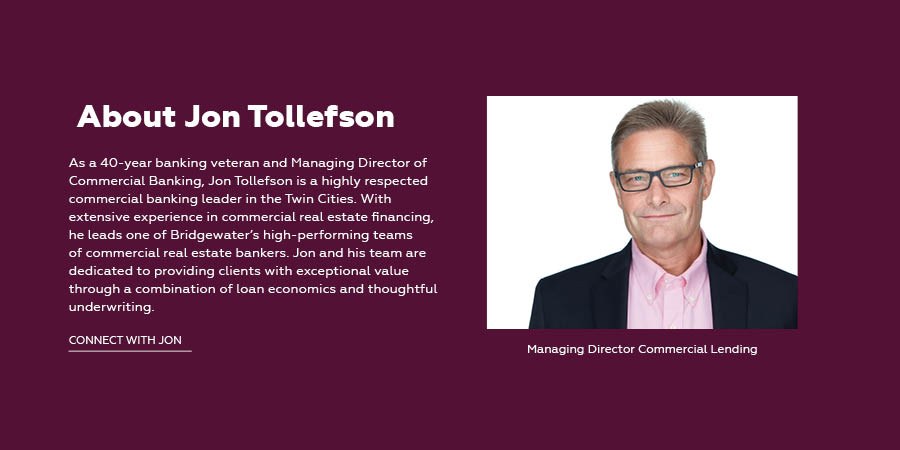
Written By: Jon Tollefson, Managing Director, Commercial Banking
As we close out 2025 and look ahead to 2026, the commercial real estate landscape continues to evolve, and many developers I talk to are asking the same questions: Where is the CRE market heading next? Are conditions finally stabilizing? And is 2026 shaping up to be a better year to move projects forward?
While the year began with cautious optimism, recent trends suggest a more stable and opportunity-rich environment for developers and investors alike. Let’s take a look at what we’re seeing and discuss tips for success in 2026:
Trends Worth Talking About
1. A Softer Rate Environment Is Opening Doors
After prolonged inversion, the yield curve has finally normalized, with the 2–10 Treasury spread sitting around +50 basis points. The 10-year Treasury is holding near 4%, and the effective Fed Funds Rate is now around 3.75%, following the Federal Reserve’s recent rate cut.
That may sound like a small shift, but for developers, it’s meaningful. A softer rate environment is leading to:
- Better access to both equity and debt
- Some loosening of underwriting standards at community banks
- Slightly lower equity requirements and stronger loan proceeds
In other words, more projects are starting to pencil again.
2. Financing Momentum Is Real, and Creativity is Driving It
We saw CRE lending pick up in Q1 2025, with the CBRE Lending Momentum Index up 90% year-over-year. Local banks, including Bridgewater, are seeing more activity, especially in the multifamily and industrial sectors.
Developers are also using creative capital stacks, blending senior loans, mezzanine debt, and preferred equity, to navigate today’s underwriting environment.
Overall, the Bridgewater team and I have seen a noticeable uptick in financing requests and new loan pipeline, driven both by loan maturities from 2020–2021 financings and renewed optimism around a “softer landing” for the economy. Developer confidence has steadily increased throughout the latter part of 2025.
3. The Urban-to-Suburban Shift Isn't Slowing Down
When it comes to multifamily, development continues to migrate outward. Suburban markets (think Eden Prairie, Bloomington West, and other high-growth pockets) are seeing stronger rent growth and absorption rates than many urban cores.
According to CoStar data, prior to the pandemic, roughly 40–45% of new multifamily supply across the seven-county metro was being delivered in Minneapolis and St. Paul. From 2023 through 2025, that share dropped closer to 30%, signaling a meaningful shift in where new development is taking place.
Why? A combination of factors:
- Concerns around taxes and rent control in urban districts
- Affordability and perceived safety in the suburbs
- Lingering work-from-home flexibility influencing where people want to live
This migration has staying power, and developers who align projects accordingly are seeing results.
4. Population Growth: Slower, but Still a Key Driver
Since 2020, the Twin Cities metro has added roughly 85,000 residents, a 2.7% growth rate that’s slower than the previous decade. But the real story is in the suburbs: Dayton, Corcoran, Lake Elmo, and other outer-ring cities continue to rank among the fastest-growing communities in Minnesota.
This expansion is driving sustained demand for both housing and commercial development. We’re seeing this firsthand, and it’s one reason we’re excited to be opening a new branch in Lake Elmo in early 2026.
5. Affordable Housing is a Hot Ticket
Another key area of opportunity is affordable housing. Rising homeownership costs and increasing market rents have created an urgent and seemingly insatiable need for more affordable housing. Matter of fact, we’ve seen demand continuing to outpace supply for many years.
At Bridgewater, we’re uniquely passionate about affordable housing because it’s a chance to serve our borrowers while addressing a societal need and making a lasting impact locally and nationally. As leaders in this space, we equip developers with the deep expertise, responsive support, and flexible lending options they need to succeed, from tax credit equity bridge loans to construction and permanent lending.
Tips for Developers Planning Ahead
1. Research Your Market Thoroughly
First, it's critical to study your submarket closely: new supply, repositioned assets, demographic shifts, and absorption trends. This is where good projects rise or fall.
2. Stay Ahead of Your Maturities
Many loans originated in 2020–2021 are coming due. We recommend starting refinance conversations early and considering laddering maturities to balance rate and term risk.
Bridge loans may also be worth a look if you need more runway. And don’t overlook interest rate swaps! They can create attractive fixed-rate options, especially for long-term or legacy assets.
3. Structure with Intention
Match financing to your deal’s lifecycle:
- Bridge debt may support lease-up phases.
- Flexible terms may strengthen disposition strategies.
- Recourse structure and estate planning should remain part of the conversation.
4. Partner with Local Experts
A national lender can quote terms, but a local bank can help you make decisions. Bridgewater’s relationship-driven approach, and our deep Twin Cities CRE experience, allows us to move quickly, navigate complexity, and offer guidance and creative solutionstailored to each project.
As we prepare for 2026, there’s plenty to be optimistic about. With a stabilizing rate environment, strong suburban demand, and active community bank participation, developers who plan thoughtfully and move with intention will be well-positioned heading into 2026.
If you’re evaluating opportunities or preparing for upcoming maturities, our dedicated team is here to help you think through strategy, structure, and timing. Connect with a local expert>>> https://bridgewaterbankmn.com/inquire